Blind Perspective: Crusea’s Lesson
What Leaders Are Missing
When we look forward, what do we see? Do we all see the same things? Or are they different? Do we see reality or assumption? Over and over, we have conversations and listen without labels – and all too often we think we hear and see things in very similar ways. But the truth is that we are each unique in what we see, hear, and experience, no matter how clear something may be in front of us. Perspective doesn’t just influence what we see – it determines it.
I study perspective – the perspective of the leader. Even the most attuned leaders see clearly and still miss part of the picture. The human brain has a unique override that plays tricks – often to help us create shortcuts – and the brain’s timing mechanism creates a hurry effect, where we simply see what is in front of us, regardless of the wholeness or incompleteness of the picture.
Elements throughout my office are intentionally placed to enforce the idea that what you see may not be all there is to see. I learned this long before I studied leadership. I was inspired by Crusea Pinkenson, my immigrant grandmother, who came to the States with very little, including her eyesight. She was legally blind and could only see shadows – so she had to look hard, to look deeper at the most basic things to frame her unique perspective. And through this practice, she saw what few others saw – she saw beauty in everything. As an entrepreneur, a fashion icon, a saleswoman, and a seamstress in the high fashion women’s store she and my grandfather founded in the 1940s, no one cared that she was legally blind. This was because she listened more intently, looked more deeply, and felt more intensely. Through her perspective, she reminded women then, and all of us now, that pausing to have a perspective and to look deeper at even the most basic things in front of us can change what your eyes really see.
This story plays out in different ways every day. A colleague once grew irritated by a loud group in a museum gallery. She had been carefully observing the quiet protocol, and their rising voices felt intrusive, almost careless. As she turned to say something, she had a stark realization. The very voices she wanted to silence were the only way they could see. It was a group of visually impaired students, experiencing Monet through spoken description. In that instant, her perspective shifted from annoyance to appreciation and gratitude.
Each day, we have the choice to take a deeper look. To pause and ask, “Is that all that I see?” Or, can I find more – more meaning, more beauty, more intention? As you look at the image below, what do you see?
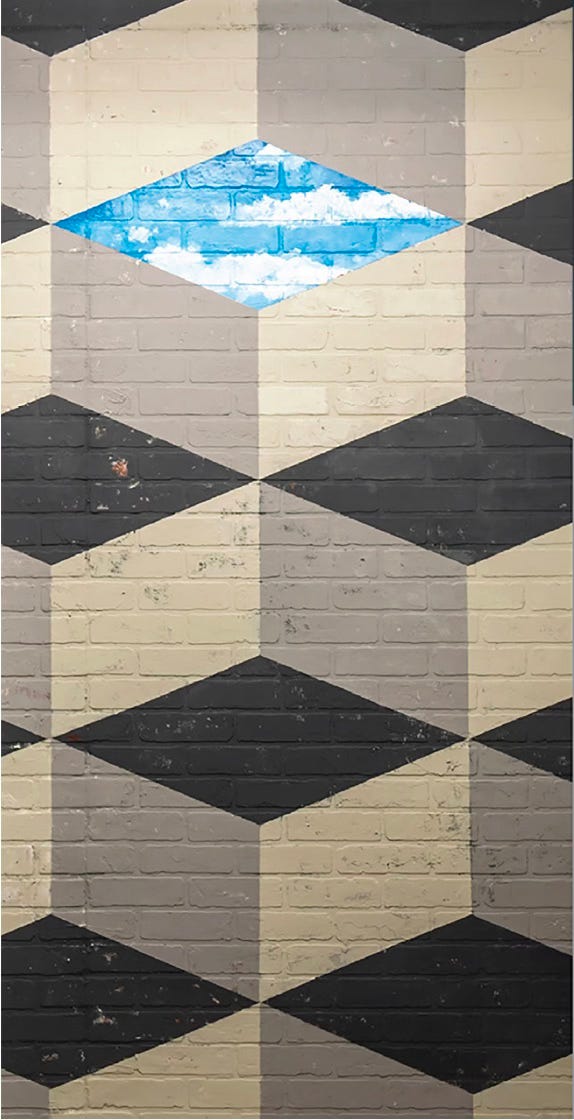
Do you see the dimensional cubes? Do you see steps? Do you see the dark gray as the top of the step? Look carefully. Is that all? Can you also see that the dark gray can be both the top and the bottom at the same time, in a blink of an eye? People experience this wall in our office differently – some can see it both ways, and others cannot see it at all. Yet it does not change the basic lesson – we all bring a unique perspective, and sometimes we don’t consider that others simply do not see the world the same way we do. Accept the difference – listen to it, learn from it, and lead through it – guided by what you see and what you hear from others, and by what they see that you cannot.
Be open to what is or could be in front of you. It may be something pure magic that has always been there. Or it may be something new that the magic of this particular moment illuminated. Whatever it is, recognize that just because you see it doesn’t mean that others see the same thing. Be open to listening and learning what they see, because it may open your mind to seeing something new too.
She and my grandfather founded one of Houston’s most fashionable women’s stores in the 40s – she was the ultimate entrepreneur – selling women clothes and reminding them, “you’re beautiful darling,” in her broken Russian accent. She was also the tailor – even though she could only see shadows. It didn’t stop her – she chose to see things through a lens of absolute positivity – reminding us “to make every day a holiday” and with her limited resources, that “we are rich with love.” So, when you look forward, ask yourself: are you seeing what’s truly there – or only what you expect to see?
Brad